
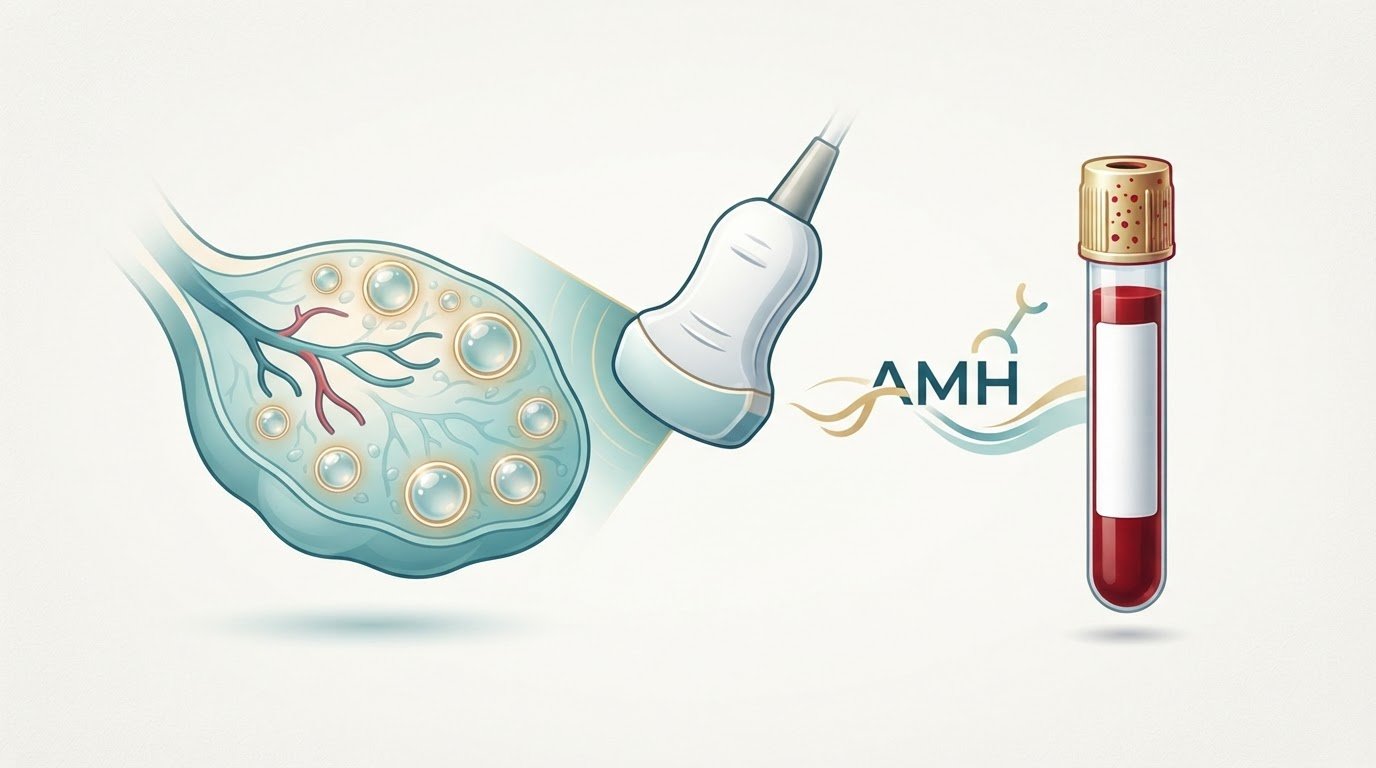
A — Attention: Low AMH but Normal AFC? What Does It Mean?
AMH vs AFC: Why do these two ovarian reserve tests sometimes give different results? Imagine receiving your fertility test reports. Your AMH blood test suggests low ovarian reserve, but your ultrasound shows a reasonable number of antral follicles.
Which report should I believe? Does this mean I cannot become pregnant?
AMH and AFC measure related aspects of ovarian reserve, but they are not identical tests. Sometimes their results disagree. Understanding why can help you make informed decisions without unnecessary anxiety.
I — Interest: Understanding AMH and AFC
What is AMH?
Anti-Müllerian Hormone (AMH) is produced by granulosa cells in developing ovarian follicles. A blood test measures its concentration and provides an indirect indication of ovarian reserve.
AMH is useful for estimating how the ovaries may respond to stimulation medicines during IVF. However, AMH cannot directly measure egg quality or accurately predict whether a woman will conceive naturally.
What is AFC?
Antral Follicle Count (AFC) is measured using transvaginal ultrasound. During the examination, the fertility specialist counts the small visible antral follicles in both ovaries, generally measuring approximately 2–10 mm.
AFC provides an estimate of the follicles available to respond during ovarian stimulation. Like AMH, it helps predict ovarian response rather than guaranteeing pregnancy.
AMH vs AFC: Key Differences
| Feature | AMH | AFC |
|---|---|---|
| Test method | Blood test | Ultrasound |
| Measures | Hormone from developing follicles | Visible small antral follicles |
| Timing | Usually possible on any cycle day | Often assessed early in the menstrual cycle |
| Main purpose | Predict ovarian response | Predict ovarian response |
| Directly measures egg quality? | No | No |
| Predicts natural pregnancy reliably? | No | No |
Why Can AMH and AFC Results Be Different?
- Biological variation: The tests represent different biological measurements, so results may be discordant.
- Laboratory differences: AMH results can vary by assay and reference interval.
- Ultrasound-related differences: AFC can vary with examiner experience, equipment and ovarian visibility.
- Hormonal influences: Hormonal contraception and some ovarian conditions may affect results.
- Individual characteristics: Age, prior ovarian surgery, endometriosis and reproductive history can affect ovarian reserve markers.
A difference between AMH and AFC does not automatically mean that either report is incorrect.
D — Desire: What Do These Results Mean for Your Fertility Treatment?
Low AMH does not mean pregnancy is impossible
Low AMH may suggest reduced ovarian response to stimulation, but it does not establish infertility or rule out natural pregnancy. Age, reproductive history, ovulation, fallopian tubes and sperm parameters remain important.
Why age matters
AMH and AFC mainly provide information about follicle quantity. Age is more strongly associated with reproductive potential and changes in egg chromosomal quality. Women with similar AMH values may have very different fertility prospects.
What if AMH is low but AFC is normal?
Your specialist may review the laboratory report, ultrasound findings, medical history and any previous response to fertility medication. This pattern does not automatically mean IVF is necessary.
What if AMH is normal but AFC is low?
This also calls for individual assessment. Ultrasound technique, examination timing and prior investigations may help explain the discrepancy.
Do you always need both tests?
Not necessarily. Current fertility guidance recognises either AMH or AFC as useful for predicting ovarian response. Using both routinely does not consistently improve prediction, although further assessment may help in selected situations.
A — Action: Understand Your Ovarian Reserve Before Making Decisions
If you have conflicting AMH and AFC results, avoid making decisions based on one number alone. A comprehensive fertility evaluation can help clarify what the results mean for you.
Consult Dr Ankush Raut, Fertility and IVF Specialist in Mumbai, for personalised evaluation and discussion of appropriate options. Book a fertility consultation.
Frequently Asked Questions
Can I conceive naturally with low AMH?
Yes. Natural pregnancy is possible with low AMH. AMH alone does not reliably predict natural conception.
Which is more accurate: AMH or AFC?
Both are accepted tests for predicting ovarian response. Neither is universally superior; interpretation depends on clinical context.
Does normal AFC mean good egg quality?
No. AFC estimates follicle number, not the chromosomal or developmental quality of eggs.
Should I repeat AMH if it disagrees with AFC?
Not automatically. A specialist may recommend reassessment if results are unexpected or could change management.
Can AMH or AFC predict IVF success?
They help predict ovarian response and expected egg yield, but have limited ability to predict pregnancy and live birth.
Related Reading
References
- American Society for Reproductive Medicine. Testing and Interpreting Measures of Ovarian Reserve (2020).
- European Society of Human Reproduction and Embryology. Ovarian Stimulation for IVF/ICSI: Guideline Update (2025).
- World Health Organization. Diagnosis of Infertility.
Medical disclaimer: This article is intended for general patient education and does not replace individual medical evaluation, diagnosis or treatment advice.